Every leadership decision about team composition is a strategic bet. You can prioritize short-term execution or long-term capability building, but rarely both equally. An important skill of leadership is building teams, or the ability to decide how to bring together a set of people to effectively solve a problem or achieve an objective. This skill can be applied at the smallest scale with just a single person selected for a targeted purpose, such as a team lead assigning a team member to a task.
This exercise in decision making can be scaled up multiple levels to larger and larger scopes of teams, where at some point the leader is no longer making decisions about assigning individuals to tasks, but rather organizing teams or groups of teams around a strategic priority. When you start to have to consider this scope of leadership in building teams and organizations to solve problems, a key trait that begins to emerge is what I've dubbed healthy tension.
Healthy tension, at its core, is as follows: the organizational dynamic that emerges from the decision of a leader by aligning a group of people or teams around a common set of goals while deliberately placing their strategy, tactical approaches, values, and/or priorities at odds with each other.
When building teams, the most intuitive trait to prioritize is strong collaboration and good chemistry. As a leader, you would prefer that your team, simply put, gets along. However, even in the smallest of scales (think a "1 pizza team": small enough to feed with a single pizza order, typically 6-8 people), what you don't want is a notion of "groupthink". Strong teams are built on a foundation of shared purpose but diverse approach and opinion. The best and most effective teams find ways to promote individual thought while working through disagreement in healthy and productive ways towards a common goal.
To better describe this idea, I'd like to describe a hypothetical organizational structure where a focused effort to have teams at odds with one another could be the right if not the best structure to achieve an objective.
A senior leader in charge of a factory responsible for producing "widgets" has been tasked by their shareholders and board to increase overall operating profits and reduce the amount of lost revenue due to defective product exiting the production line and having to either be trashed or returned by customers.
The leader has a decision to make. How to split up their team to effectively achieve the objectives laid out to them. The leader decides to organize their factory from the existing pool of employees into the following teams:
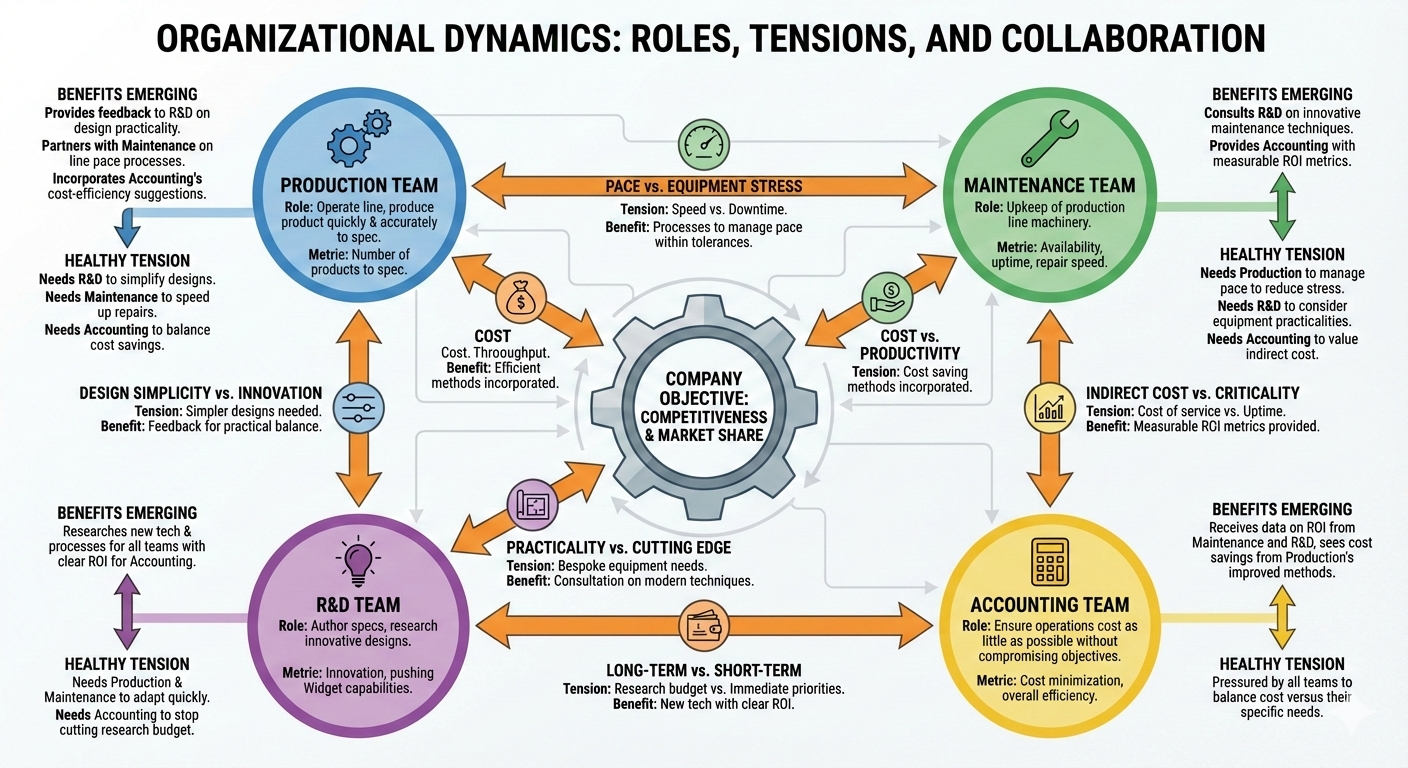
The Production team is responsible for the operation and functioning of the line are given the priorities to produce product as quickly and accurate to spec as possible. They are measured on number of product created to spec with any not created to spec not counting to the total. The spec is provided by the R&D team.
The Maintenance team is responsible for the upkeep of the production line machinery. They are measured on the overall availability and uptime of the machinery as well as how quickly they are able to perform repairs.
The R&D team is responsible for authoring the spec used by the Engineering team and built by the production machinery. Their priority is to do research to create the most innovative designs and push the boundaries of Widget capabilities to maintain competitiveness in the market.
The Accounting team is responsible for ensuring all operations are costing as little as possible without compromising on any of the other objectives.
Now consider the healthy tension present with this organizational structure.
The Production team:
Needs the R&D team to simplify their designs to make them easier to produce
Needs the Maintenance team to speed up their repairs so the line can be down for less time
Needs the accounting team to find a better balance on cost saving measures that don't impact the overall productivity of the line
The Maintenance team:
Needs the Production team to manage the pace of their work to not to require increased maintenance and repairs due to the high stress on the equipment caused by the high pace of production and ultimately leads to more issues, repairs needed, and downtime.
Needs the R&D team to consider the practical requirements of their "cutting edge" designs on the corresponding bespoke and hard to maintain production line equipment it requires.
Need the accounting team to consider the cost of their services, while indirect, just as critical to the overall organization's objective lest the production line be constantly broken and limping along without proper maintenance
The R&D team:
Need the Production and Maintenance teams to adapt to new designs quicker so that the company can iterate on the shipping the latest Widget and capture market share as quickly as possible
Needs the accounting team to stop cutting the research budget as a long-term priority in favor of the shorter term priorities of Production and Maintenance
This might at first seems like the most dysfunctional organization this poor, misinformed leader could have ever put together. But healthy tension in an organization can only be effective with a set of core values and strong team culture holding it together. A critical, uncompromising responsibility of the senior leader establishing the healthy tensions is also to set a culture of collaboration and shared success (and failure).
The teams in our fictional production company are also built with the following precedents and instilled with the following expectations along with their priorities:
Each independent group has to go into each challenge with the best intentions for their partner teams. They have to understand that one of their core deliverables is collective success. Success that comes at another group's expense isn't success at all. Therefore, they must find ways to collaborate and work out differences in opinion in productive rather than combative ways.
Each group is expected to come up with solutions in collaboration with their partner teams and not simply escalate disagreements to upper management unless it requires an explicit decision outside or across the scope of either group.
Now consider the benefits that emerge with the described objective, org structure, team priorities, shared core values, and expectations:
The Production team
Provides feedback to the R&D team on how to include adjustments to their upcoming design based on the practicality of production for the current iteration that finds a healthy balance between innovation and efficiency of production
Partners with the Maintenance team to create processes to manage the pace of the production line within tolerances of the equipment to minimize issues and subsequent repairs.
Incorporates suggestions from the accounting team for production methods that increase cost efficiency without meaningfully compromising on overall production throughput
The Maintenance team
Consults with the R&D team on more modern and innovative techniques to perform maintenance and repairs more efficiently
Provide the accounting team with measurable metrics on the return on investment for a robust maintenance process and routine
The R&D team
Researches new technologies and develops new processes for all other teams that the accounting team could directly relate back to return on investments and cost savings
If you have spent any time in a large, multi-disciplinary professional environment, you can likely map these fictional teams directly to roles in your own organization. The specific scope and resulting healthy tensions might vary, but I think its highly likely you could discern what your organization's version of this healthy tension might be.
In my opinion, the real strength of this dynamic is its inherent self-sufficiency. Assuming there is a set of core values that each member of the organization holds themselves to, the overall effectiveness of the organization scales proportionally to the collective strength of the independent teams. The higher the healthy tension, the higher the possibility and degree of success. As leaders, I believe we should all consider looking at our organizations, large or small, through this lens of healthy tensions and determine how to best configure it to be in balance and serving a collective objective. What tensions exist in your organization today that, if acknowledged and channeled productively, could drive better outcomes?
The post was authored with editorial support (Claude Opus 4.5) and image generation (Nano Banana 3 Pro) from Generative AI. All words are my own.
Webmentions
---
title: "Healthy Tension"
subtitle: "The Organizational Dynamic That Drives High-Performing Teams"
date: 2025-12-31
tags: ["leadership", "career"]
---
Every leadership decision about team composition is a strategic bet. You can prioritize short-term execution or long-term capability building, but rarely both equally. An important skill of leadership is building teams, or the ability to decide how to bring together a set of people to effectively solve a problem or achieve an objective. This skill can be applied at the smallest scale with just a single person selected for a targeted purpose, such as a team lead assigning a team member to a task.
This exercise in decision making can be scaled up multiple levels to larger and larger scopes of teams, where at some point the leader is no longer making decisions about assigning individuals to tasks, but rather organizing teams or groups of teams around a strategic priority. When you start to have to consider this scope of leadership in building teams and organizations to solve problems, a key trait that begins to emerge is what I've dubbed **healthy tension**.
**Healthy tension**, at its core, is as follows: *the organizational dynamic that emerges from the decision of a leader by aligning a group of people or teams around a common set of goals while deliberately placing their strategy, tactical approaches, values, and/or priorities at odds with each other.*
When building teams, the most intuitive trait to prioritize is strong collaboration and good chemistry. As a leader, you would prefer that your team, simply put, gets along. However, even in the smallest of scales (think a "1 pizza team": small enough to feed with a single pizza order, typically 6-8 people), what you don't want is a notion of "groupthink". Strong teams are built on a foundation of shared purpose but diverse approach and opinion. The best and most effective teams find ways to promote individual thought while working through disagreement in healthy and productive ways towards a common goal.
To better describe this idea, I'd like to describe a hypothetical organizational structure where a focused effort to have teams at odds with one another could be the right if not the best structure to achieve an objective.
> A senior leader in charge of a factory responsible for producing "widgets" has been tasked by their shareholders and board to increase overall operating profits and reduce the amount of lost revenue due to defective product exiting the production line and having to either be trashed or returned by customers.
The leader has a decision to make. How to split up their team to effectively achieve the objectives laid out to them. The leader decides to organize their factory from the existing pool of employees into the following teams:
- **The Production team** is responsible for the operation and functioning of the line are given the priorities to produce product as quickly and accurate to spec as possible. They are measured on number of product created to spec with any not created to spec not counting to the total. The spec is provided by the R&D team.
- **The Maintenance team** is responsible for the upkeep of the production line machinery. They are measured on the overall availability and uptime of the machinery as well as how quickly they are able to perform repairs.
- **The R&D team** is responsible for authoring the spec used by the Engineering team and built by the production machinery. Their priority is to do research to create the most innovative designs and push the boundaries of Widget capabilities to maintain competitiveness in the market.
- **The Accounting team** is responsible for ensuring all operations are costing as little as possible without compromising on any of the other objectives.
Now consider the healthy tension present with this organizational structure.
The Production team:
- Needs the R&D team to simplify their designs to make them easier to produce
- Needs the Maintenance team to speed up their repairs so the line can be down for less time
- Needs the accounting team to find a better balance on cost saving measures that don't impact the overall productivity of the line
The Maintenance team:
- Needs the Production team to manage the pace of their work to not to require increased maintenance and repairs due to the high stress on the equipment caused by the high pace of production and ultimately leads to more issues, repairs needed, and downtime.
- Needs the R&D team to consider the practical requirements of their "cutting edge" designs on the corresponding bespoke and hard to maintain production line equipment it requires.
- Need the accounting team to consider the cost of their services, while indirect, just as critical to the overall organization's objective lest the production line be constantly broken and limping along without proper maintenance
The R&D team:
- Need the Production and Maintenance teams to adapt to new designs quicker so that the company can iterate on the shipping the latest Widget and capture market share as quickly as possible
- Needs the accounting team to stop cutting the research budget as a long-term priority in favor of the shorter term priorities of Production and Maintenance
This might at first seems like the most dysfunctional organization this poor, misinformed leader could have ever put together. But healthy tension in an organization can only be effective with a set of core values and strong team culture holding it together. A critical, uncompromising responsibility of the senior leader establishing the healthy tensions is also to set a culture of collaboration and shared success (and failure).
The teams in our fictional production company are also built with the following precedents and instilled with the following expectations along with their priorities:
- Each independent group has to go into each challenge with the best intentions for their partner teams. They have to understand that one of their core deliverables is **collective success**. Success that comes at another group's expense isn't success at all. Therefore, they must find ways to collaborate and work out differences in opinion in productive rather than combative ways.
- Each group is expected to come up with solutions in collaboration with their partner teams and not simply escalate disagreements to upper management unless it requires an explicit decision outside or across the scope of either group.
Now consider the benefits that emerge with the described objective, org structure, team priorities, shared core values, and expectations:
The Production team
- Provides feedback to the R&D team on how to include adjustments to their upcoming design based on the practicality of production for the current iteration that finds a healthy balance between innovation and efficiency of production
- Partners with the Maintenance team to create processes to manage the pace of the production line within tolerances of the equipment to minimize issues and subsequent repairs.
- Incorporates suggestions from the accounting team for production methods that increase cost efficiency without meaningfully compromising on overall production throughput
The Maintenance team
- Consults with the R&D team on more modern and innovative techniques to perform maintenance and repairs more efficiently
- Provide the accounting team with measurable metrics on the return on investment for a robust maintenance process and routine
The R&D team
- Researches new technologies and develops new processes for all other teams that the accounting team could directly relate back to return on investments and cost savings
If you have spent any time in a large, multi-disciplinary professional environment, you can likely map these fictional teams directly to roles in your own organization. The specific scope and resulting healthy tensions might vary, but I think its highly likely you could discern what your organization's version of this healthy tension might be.
In my opinion, the real strength of this dynamic is its inherent self-sufficiency. Assuming there is a set of core values that each member of the organization holds themselves to, the overall effectiveness of the organization scales proportionally to the collective strength of the independent teams. The higher the healthy tension, the higher the possibility and degree of success. As leaders, I believe we should all consider looking at our organizations, large or small, through this lens of healthy tensions and determine how to best configure it to be in balance and serving a collective objective. What tensions exist in your organization today that, if acknowledged and channeled productively, could drive better outcomes?
> The post was authored with editorial support (Claude Opus 4.5) and image generation (Nano Banana 3 Pro) from Generative AI. All words are my own.
Every leadership decision about team composition is a strategic bet. You can prioritize short-term execution or long-term capability building, but rarely both equally. An important skill of leadership is building teams, or the ability to decide how to bring together a set of people to effectively solve a problem or achieve an objective. This skill can be applied at the smallest scale with just a single person selected for a targeted purpose, such as a team lead assigning a team member to a task. This exercise in decision making can be scaled up multiple levels to larger and larger scopes of teams, where at some point the leader is no longer making decisions about assigning individuals to tasks, but rather organizing teams or groups of teams around a strategic priority. When you start to have to consider this scope of leadership in building teams and organizations to solve problems, a key trait that begins to emerge is what I've dubbed healthy tension. Healthy tension, at its core, is as follows: the organizational dynamic that emerges from the decision of a leader by aligning a group of people or teams around a common set of goals while deliberately placing their strategy, tactical approaches, values, and/or priorities at odds with each other. When building teams, the most intuitive trait to prioritize is strong collaboration and good chemistry. As a leader, you would prefer that your team, simply put, gets along. However, even in the smallest of scales (think a "1 pizza team": small enough to feed with a single pizza order, typically 6-8 people), what you don't want is a notion of "groupthink". Strong teams are built on a foundation of shared purpose but diverse approach and opinion. The best and most effective teams find ways to promote individual thought while working through disagreement in healthy and productive ways towards a common goal. To better describe this idea, I'd like to describe a hypothetical organizational structure where a focused effort to have teams at odds with one another could be the right if not the best structure to achieve an objective. A senior leader in charge of a factory responsible for producing "widgets" has been tasked by their shareholders and board to increase overall operating profits and reduce the amount of lost revenue due to defective product exiting the production line and having to either be trashed or returned by customers. The leader has a decision to make. How to split up their team to effectively achieve the objectives laid out to them. The leader decides to organize their factory from the existing pool of employees into the following teams: The Production team is responsible for the operation and functioning of the line are given the priorities to produce product as quickly and accurate to spec as possible. They are measured on number of product created to spec with any not created to spec not counting to the total. The spec is provided by the R&D team. The Maintenance team is responsible for the upkeep of the production line machinery. They are measured on the overall availability and uptime of the machinery as well as how quickly they are able to perform repairs. The R&D team is responsible for authoring the spec used by the Engineering team and built by the production machinery. Their priority is to do research to create the most innovative designs and push the boundaries of Widget capabilities to maintain competitiveness in the market. The Accounting team is responsible for ensuring all operations are costing as little as possible without compromising on any of the other objectives. Now consider the healthy tension present with this organizational structure. The Production team: Needs the R&D team to simplify their designs to make them easier to produce Needs the Maintenance team to speed up their repairs so the line can be down for less time Needs the accounting team to find a better balance on cost saving measures that don't impact the overall productivity of the line The Maintenance team: Needs the Production team to manage the pace of their work to not to require increased maintenance and repairs due to the high stress on the equipment caused by the high pace of production and ultimately leads to more issues, repairs needed, and downtime. Needs the R&D team to consider the practical requirements of their "cutting edge" designs on the corresponding bespoke and hard to maintain production line equipment it requires. Need the accounting team to consider the cost of their services, while indirect, just as critical to the overall organization's objective lest the production line be constantly broken and limping along without proper maintenance The R&D team: Need the Production and Maintenance teams to adapt to new designs quicker so that the company can iterate on the shipping the latest Widget and capture market share as quickly as possible Needs the accounting team to stop cutting the research budget as a long-term priority in favor of the shorter term priorities of Production and Maintenance This might at first seems like the most dysfunctional organization this poor, misinformed leader could have ever put together. But healthy tension in an organization can only be effective with a set of core values and strong team culture holding it together. A critical, uncompromising responsibility of the senior leader establishing the healthy tensions is also to set a culture of collaboration and shared success (and failure). The teams in our fictional production company are also built with the following precedents and instilled with the following expectations along with their priorities: Each independent group has to go into each challenge with the best intentions for their partner teams. They have to understand that one of their core deliverables is collective success. Success that comes at another group's expense isn't success at all. Therefore, they must find ways to collaborate and work out differences in opinion in productive rather than combative ways. Each group is expected to come up with solutions in collaboration with their partner teams and not simply escalate disagreements to upper management unless it requires an explicit decision outside or across the scope of either group. Now consider the benefits that emerge with the described objective, org structure, team priorities, shared core values, and expectations: The Production team Provides feedback to the R&D team on how to include adjustments to their upcoming design based on the practicality of production for the current iteration that finds a healthy balance between innovation and efficiency of production Partners with the Maintenance team to create processes to manage the pace of the production line within tolerances of the equipment to minimize issues and subsequent repairs. Incorporates suggestions from the accounting team for production methods that increase cost efficiency without meaningfully compromising on overall production throughput The Maintenance team Consults with the R&D team on more modern and innovative techniques to perform maintenance and repairs more efficiently Provide the accounting team with measurable metrics on the return on investment for a robust maintenance process and routine The R&D team Researches new technologies and develops new processes for all other teams that the accounting team could directly relate back to return on investments and cost savings If you have spent any time in a large, multi-disciplinary professional environment, you can likely map these fictional teams directly to roles in your own organization. The specific scope and resulting healthy tensions might vary, but I think its highly likely you could discern what your organization's version of this healthy tension might be. In my opinion, the real strength of this dynamic is its inherent self-sufficiency. Assuming there is a set of core values that each member of the organization holds themselves to, the overall effectiveness of the organization scales proportionally to the collective strength of the independent teams. The higher the healthy tension, the higher the possibility and degree of success. As leaders, I believe we should all consider looking at our organizations, large or small, through this lens of healthy tensions and determine how to best configure it to be in balance and serving a collective objective. What tensions exist in your organization today that, if acknowledged and channeled productively, could drive better outcomes? The post was authored with editorial support (Claude Opus 4.5) and image generation (Nano Banana 3 Pro) from Generative AI. All words are my own.